Most Pinterest results for old money outfits get the aesthetic wrong. They show expensive-looking clothes on thin models with vague captions about “timeless elegance” and leave it at that. The actual old money aesthetic is not about buying expensive things. It is about a specific set of rules around color, fit, fabric, and restraint that signals wealth without announcing it. The clothes whisper. Nothing shouts.
This guide explains what defines the aesthetic, which key pieces build it, and how the palette and fabrics work. Then it walks through outfit formulas from white neutrals and button-downs to cooler-weather layers. For neighboring aesthetics, see luxury fashion aesthetic, dark academia, and corporate baddie.
What defines the old money aesthetic
The name comes from the social term “old money,” which describes a social class of the rich who have been able to maintain their wealth over multiple generations, in contrast with new money. The fashion version borrows that idea of inherited ease. Clothes look lived-in, well kept, and unbothered by trends, because the wearer has nothing to prove.
Visually, the aesthetic draws on preppy style: blazers, oxford shirts, pleated skirts, loafers, and sweaters knotted or draped over the shoulders. It overlaps with what fashion media now calls quiet luxury, where quality of fabric and cut replaces visible logos. The three ideas share one principle: restraint is the signal.
Key pieces for old money outfits
- A navy blazer with gold or horn-style buttons
- A crisp white button-down in cotton or linen
- High-waisted trousers in beige, cream, or navy
- A cable-knit sweater in camel, cream, or navy
- A pleated skirt that ends at or below the knee
- A brown or black leather belt and a structured handbag
- Loafers, ballet flats, or clean white sneakers
Palette and fabrics
Old money starts with a restricted palette: white, cream, beige, navy, and black, with camel and a single muted accent for autumn. The discipline of staying within these colors is what gives the outfits their visual coherence. When every piece lives in the same tonal family, the outfit looks expensive even when the individual items are not.
Fabric does the rest. Look for cotton with some weight, linen, wool, cashmere blends, and real leather. Heavy cotton drapes without clinging, and natural fibers age better than thin synthetics. A plain tee in dense cotton reads more expensive than a flimsy one with a logo, and that is the aesthetic in one sentence.
The white and neutral foundation
The outfits below show the palette in practice. Each one stays inside two or three neutrals and lets one accessory carry the point of interest.
White Blazer With Pleated Skirt
Image: Pinterest
A white sleeveless blazer with a pleated skirt, white flats, and a quilted black handbag. This is the old money template in its purest form. The blazer provides structure at the shoulder. The pleated skirt adds movement below the knee. The flats signal that nobody is trying to impress anyone, which is the entire point. The formula repeats across resort towns and wealthy neighborhoods because the consistency is the tell.
White Tank With Wide-Leg Trousers
Image: Pinterest
A simple white tank top with high-waisted wide-leg trousers and a brown leather belt. The belt is doing all the work here. It creates a waist definition point between the slim tank and the flowing trouser, and the brown leather against all that white is the only color contrast in the entire outfit. Old money dressing uses accessories as the single point of interest rather than distributing visual weight across multiple pieces. One belt, one bag, done.
White Tee With High-Waisted Trousers
Image: Pinterest
A crisp white tee with high-waisted wide-leg trousers and minimal accessories. The simplicity is deliberate. In the old money framework, a plain white tee is not basic. It is a statement that no logo, pattern, or graphic is needed to communicate status. The tee should fit well (not tight, not oversized) and the fabric should be heavy enough to drape cleanly. An inexpensive cotton tee with real weight often does this better than a thin designer option.
All-White Summer Outfit
Image: Pinterest
A white tank with white shorts and a gold belt. The all-white outfit is old money’s boldest move because it requires confidence and maintenance. White shows everything: wrinkles, stains, poor fabric. Head-to-toe white signals the lifestyle to keep it clean, which is a quiet flex. The gold belt is the only metallic element, and gold is the old money metal. Silver reads younger and more casual. Gold reads inherited.
The button-down as uniform
If old money had a uniform piece, it would be the button-down shirt. Specifically, a slightly oversized cotton or linen button-down in white, blue, or a muted stripe. The button-down appears in more old money outfits than any other single item because it communicates formality without formalwear. It is the piece that says “I have standards” without saying “I am going to an event.”
Striped Button-Down With Beige Shorts
Image: Pinterest
A classic striped button-down tucked into high-waisted beige shorts with a brown leather belt and matching handbag. The tuck is non-negotiable in old money styling. An untucked button-down looks like casual Friday at an office. A tucked button-down with matching belt and bag looks like money. The stripe is subtle: thin, regular, and in a color that does not compete with the shorts. This combination works for brunch, shopping, or any daytime event that calls for polish without looking overdressed.
Blue Oxford With White Shorts
Image: Pinterest
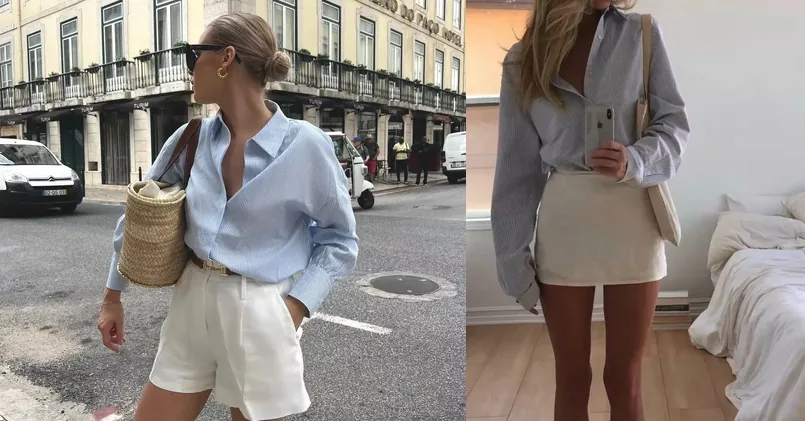
A blue button-down with white shorts, oversized sunglasses, gold hoops, and a straw bag. The straw bag is the summer old money accessory. It signals leisure, vacation, and a certain ease with the outdoors that expensive living provides. A woven straw tote changes how an entire warm-weather wardrobe reads, because it turns jeans and a tee into something that looks considered.
White Shirt With Jeans and Draped Sweater
Image: Pinterest
A white button-down, high-waisted jeans, and a red sweater draped over the shoulders. The shoulder drape is the single most old money styling move that exists. Nobody who is running errands drapes a sweater over their shoulders. It is a gesture that says “at leisure, and happy for it to show.” The red sweater against the white shirt is the pop of color, and it is the only color in the outfit. One accent, everything else neutral. That ratio never changes.
Striped Shirt With White Mini Skirt
Image: Pinterest
An oversized striped button-down with a high-waisted white mini skirt. The oversized fit looks borrowed from someone (a boyfriend, a father, a partner), which carries its own old money coding: access to a larger wardrobe, enough comfort to wear it casually, and no worry that it is too big. The mini skirt balances the volume of the oversized shirt by showing the leg, which keeps the outfit from drowning the body.
Color strategy: black, beige, and restraint
Outside the whites and blues, old money uses black and beige as the secondary palette. The rule is that no outfit contains more than three colors total, and at least two of those colors must be neutral. This restriction is what gives old money outfits their visual quiet. Nothing competes for attention.
Black Top With Beige Trousers
Image: Pinterest
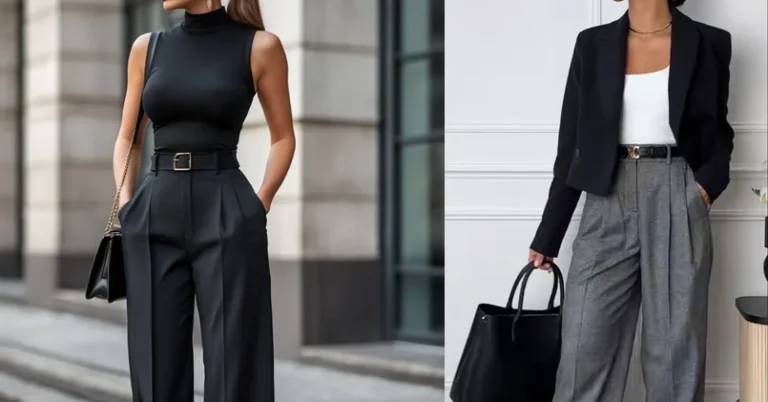
A black sleeveless top with high-waisted beige trousers, a white handbag, and classic sunglasses. Black and beige is the old money combination that works in every season and every city. The contrast is high enough to create visual interest but low enough to stay within the quiet palette. This is the best outfit for a first try at old money styling because it uses pieces most people already own. The sunglasses add the finishing layer of composure that the aesthetic requires.
All-Black Monochrome
Image: Pinterest
A black sleeveless top with tailored black shorts, a belt, and minimal accessories. All-black old money differs from all-black date night styling in the fit: old money is tailored but not tight, structured but not bodycon. The shorts hit at mid-thigh, not higher. The top has clean lines, not draping or cutouts. Every element is restrained, and the restraint itself is the message.
White Ribbed Dress With Structured Bag
Image: Pinterest
A long ribbed white dress with a structured handbag and classic sunglasses. The one-piece approach to old money: the dress does everything, and the accessories provide the only visual variation. Ribbed fabric adds texture that prevents the single-color dress from looking flat. The structured bag is essential because a slouchy bag with this dress would pull the look toward casual beach territory. Old money requires structure in at least one element of every outfit.
Layering for cooler weather
Old money outfits transition to cold weather through layering with specific pieces: cable-knit sweaters, blazers, and overcoats in navy, camel, or charcoal. The layering follows the same restraint principle. Each layer adds warmth and texture but stays within the neutral palette. The dark academia aesthetic overlaps here, but old money uses cleaner lines and fewer patterns.
Camel Sweater Over White Shirt With Navy Skirt
Image: Pinterest
A camel cable-knit sweater layered over a white shirt with a navy mini skirt and knee-high brown leather boots. Three neutrals, three textures (cable knit, cotton, leather), three levels of visual interest. The white collar peeking above the sweater neckline is the detail that makes this look styled rather than thrown on. The boots add the leg coverage that the mini skirt removes, creating a balance between skin showing and fabric covering. It is the strongest fall old money formula in this guide.
Black Outfit With Cream Shoulder Sweater
Image: Pinterest
Black trousers, a black top, and a cream sweater draped over the shoulders with white sneakers and a black handbag. The shoulder drape again, but this time the sweater provides the color contrast instead of the outfit itself. Black underneath, cream on top. This is the transitional old money outfit: warm enough for early autumn evenings, polished enough for a dinner reservation, and the white sneakers keep it from tipping into formalwear territory.
Navy Blazer Dress With Patterned Tights
Image: Pinterest
A navy double-breasted blazer dress with patterned tights, black ankle boots, and a quilted handbag. The blazer dress is old money’s answer to the question “how do I dress up without wearing a cocktail dress?” Double-breasted buttons are a heritage detail that signals traditional tailoring. The patterned tights are the single adventurous element, and even they stay within the dark color family. This is evening old money: structured, dark, and commanding.
Navy Blazer With Jeans and Structured Bag
Image: Pinterest
A tailored navy blazer with gold buttons over a white top and high-waisted jeans with a black handbag. The navy blazer with gold buttons is possibly the single most old money item in women’s fashion. It references yacht clubs, prep schools, and inherited wardrobes all at once. Pairing it with jeans is what makes it modern: the blazer provides the heritage, the jeans prevent it from becoming a costume. A vintage blazer from a consignment store often looks better than a new one at ten times the price.
White shirt, navy blazer, brown belt
Start with five pieces: a white button-down shirt, high-waisted beige or cream trousers, navy blazer, a brown leather belt, and a structured handbag in black or brown. Those five items create the core of every outfit in this guide. The quality of the fabric matters more than the brand name, which is the entire old money philosophy in one sentence. A well-made linen shirt from a high-street label looks more expensive than a wrinkled shirt from a trendy label at five times the price. The fit should be tailored but never tight. If the outline of anything underneath shows, it is too fitted for this aesthetic.
What colors are old money style?
White, cream, beige, navy, black, and camel. The palette is almost entirely neutral. Color accents appear in one piece only (a red sweater, a green bag) and must stay muted. Neon, bright patterns, and visible logos are outside the aesthetic.
Can you do old money on a budget?
Yes. The aesthetic values fit and fabric over brand names. Thrift stores and consignment shops are the best sources for blazers, leather belts, and structured bags. A vintage blazer with quality buttons looks more expensive than most fast-fashion alternatives.
What shoes work with old money outfits?
Loafers, ballet flats, clean white sneakers, and knee-high leather boots. The shoes should be polished and simple. Chunky sneakers, platforms, and anything with visible branding fall outside the aesthetic. Pointed-toe heels work for evening.